
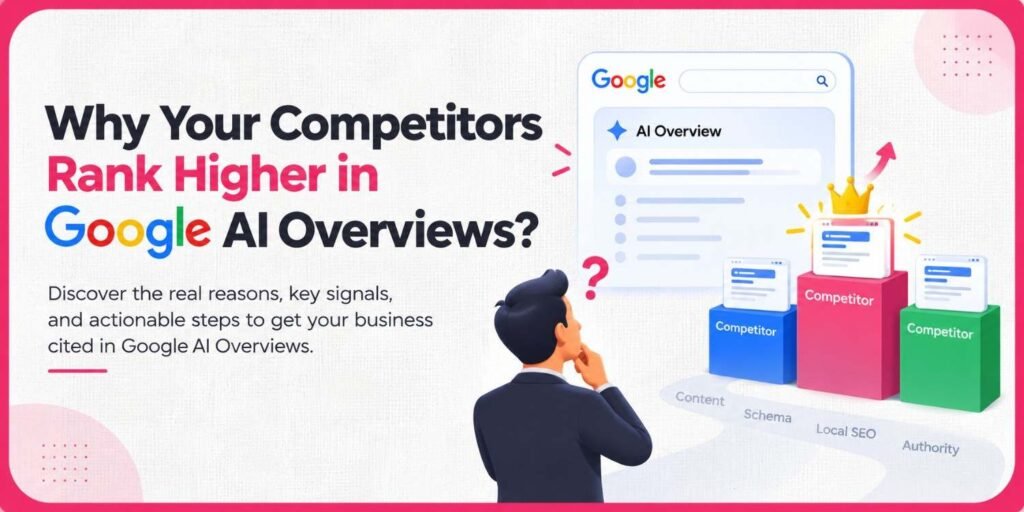
When you ask your friend to recommend a good doctor, they usually think beyond the doctor’s name. Your friend will consider what exactly the doctor specializes in, where they practice, what people really say about them, and if they are right for your particular problem or not. Google AI overviews also work in this same way. Your competitors may not always rank about you, but ig Google has stronger signals connecting their business with the right service, expertise, along with location, then it may choose them as a source. Understanding these signals is essential if you also want to rank higher in Google AI Overviews.
So, what is giving your competitors the edge? In this guide, we’ll explore how high-quality content, structured data, local SEO, entity positioning, and topical authority can strengthen your business’s relevance and credibility. And how it increases the chances of being surfaced and cited by Google itself.
What Does It Actually Mean to Rank Higher in Google AI Overviews?
Suppose you rank #1 organically, but Google cites your competitor in the AI Overview. That doesn’t mean that Google is ignoring your ranking. Here, AI Overviews can synthesize information from multiple sources and choose pages that best match the query and give clear, relevant, and trustworthy information.
Now, ranking higher in Google Overviews isn’t just about reaching a fixed position. And, there’s no guaranteed AI overview ranking or any score. The real goal is to make your business easy for Google to understand, verify, and associate with the right services, expertise, audience, and location.
Google AI Overviews Don’t Work Like a Traditional #1 Ranking
Traditional SEO keeps its focus heavily on search position. On the other hand, AI Overviews focus more on whether your content is a reliable source for a specific query or not. Google needs to understand:
- What your business offers
- Where and whom you serve
- How your content answers the search intent
- Whether your business information is consistent and trustworthy
- Whether your website is technically accessible
That’s where structured data, schema markup, local SEO, entity positioning, topical authority, and quality content work together. Furthermore, schema helps Google to precisely understand your business and content; however, it does not guarantee an AI Overview citation.
Why Your Competitors Appear in Google AI Overviews While You Don’t
If Google is citing your competitors but not you, then look beyond just rankings. The real gap may be how clearly Google understands their entity, content, expertise, and local relevance.
Google Understands Their Business Entity Better
Google needs clear signals regarding who the business is, what it exactly offers, and where it is being operated. Consistent business details, Google Business Profile, relevant Schema, SameAs profiles, brand mentions, and some third-party trusted references strengthen the entity positioning.
Their Content Answers the Query Better
It’s not always enough to be longer. But content that provides a direct answer, useful context, accurate information, examples, and first-hand insights better matches search intent and gives AI systems a stronger source to utilize.
Their Local Signals Are Stronger
For local searches, Google must connect the service with the location. A “makeup studio in Lucknow” needs much stronger local context than a generic agency page. GBP relevance, location pages, NAP (Name, Address, Phone number) consistency, citations, reviews, backlinks, along with other local mentions all contribute.
Their Business Information Stays Consistent
Your website, Google Business Profile, directories, social profiles, as well as other platforms should reinforce the same core information. If your business details conflict, then it can weaken entity clarity and local search signals.
They Build Stronger Topical Authority
One article can’t show expertise. However, a connected combination of service pages, blogs, FAQs, case studies, comparisons, and supporting topics has the potential to create a stronger topical footprint and provide Google with more context about the business.
Their Pages Are Easier to Interpret
Clear headings, descriptive titles, crawlable content, internal links, and clean page structure help search systems comprehend your information. Structured data can add useful context, but it also supports broader SEO and entity signals instead of guaranteeing an AI Overview citation.
The Role of Schema Markup in Google AI Overview Visibility
Actually, schema markup gives Google clearer, machine-readable context about your business, pages, services, and content. Moreover, it can strengthen entity understanding, content classification, and search visibility, but it’s not a shortcut to AI Overviews.
- Organization Schema: Helps Google identify your business and connect key entity details.
- LocalBusiness Schema: Clarifies your business type, location, and local presence.
- Service Schema: Defines the services your business offers.
- Article Schema: Helps Google understand informational and blog content.
- Breadcrumb Schema: Shows where a page sits within your website structure.
- FAQ Schema: Where appropriate, structures relevant FAQs when the markup genuinely matches the page content.
9 Things You Can Do to Increase Your Chances of Appearing in Google AI Overviews
You can start by understanding what Google is already rewarding, then strengthen the signals your competitors have really developed. These 9 steps give you a practical way in order to improve your AI search visibility:
1. Find the Searches That Show AI Overviews
Start with the queries that your customers actually search. Take a look at your important service, informational, and local keywords in order to see where Google AI Overviews appear. This helps you to maintain your focus on AI Overview SEO efforts on searches that matter to your business.
2. See Which Competitors Get Cited
Don’t just ask, “Who ranks above me?” Ask, “Which sources does Google trust enough to cite?”
Research the competitors appearing in AI Overview citations. Then, compare their content, expertise, entity signals, local relevance, and page structure. This competitor-citation analysis can reveal gaps that traditional rank tracking misses.
3. Understand What Google Connects to the Search
Search your target queries and note the businesses, services, locations, topics, and other entities that repeatedly appear. Thereafter, check if your website clearly establishes the same relationships or not.
This strengthens entity SEO and helps Google understand what your business is relevant for.
4. Give Better and More Complete Answers
Do not add words simply to make the page longer. You need to make the answer more useful.
Cover the main question first, followed by crucial related questions, examples, facts, and practical details. Here, clear headings and concise answers also make content easier for AI search systems to interpret.
5. Connect Your Related Content
Your core pages should not stand alone. Link among service pages with relevant blogs, FAQs, case studies, and supporting resources.
This is because a local internal linking structure helps Google understand how your topics connect and strengthens topical authority across your website.
6. Use the Right Schema Markup
Utilize relevant structured data to give search engines clearer context about your business and content. Depending on the page, this could include:
- Organization Schema
- LocalBusiness Schema
- Service Schema
- Article Schema
- Breadcrumb Schema
Keep your markup accurate and consistent with visible content. Schema always supports AI Overview SEO, but it can’t guarantee AI Overview citation.
7. Improve Your Local SEO Signals
If you serve a specific location, make the service + location + business relationship clear.
Focus on signals such as:
- An accurate Google Business Profile
- Consistent NAP information
- Useful location-specific pages
- Relevant local citations
- Genuine reviews and local mentions
- Locally relevant backlinks
Together, these signals can strengthen both local search visibility and AI search visibility.
8. Get Mentions From Trusted Websites
Google can learn about your business from your own website. Relevant industry platforms, local publications, directories, partnerships, and genuine editorial mentions can also reinforce your expertise and business entity.
Prioritize relevant, credible mentions rather than collecting backlinks simply for volume.
9. Track Your AI Overview Visibility
AI Overview results vary over time. So, check your priority queries and record regularly, such as:
- Which competitors are being cited
- Which pages Google uses
- What information is being highlighted
- Where your content falls short
Use these insights in order to improve your content, entity signals, and overall Google AI strategy.
Conclusion
Being visible in Google AI Overviews actually starts with becoming the source Google can confidently understand and reference. So, it means building a recognizable digital presence, answering specific questions with real value, and reinforcing your expertise across relevant sources.
If your competitors are getting the citations you want, then AdiFlare, one of the leading digital marketing agencies in Lucknow, can analyze those gaps and build a structured schema markup and local entity positioning strategy to strengthen your AI search presence.